Anthropic Wins Its First Court Fight Over the Pentagon's 'Supply-Chain Risk' Label
A federal judge rules that labeling Anthropic a supply-chain risk was illegal — and that resetting the frame matters more than the headline.
Earlier this week, a federal judge handed Anthropic its first court victory over the U.S. government’s handling of its relationship with the Pentagon. The ruling centers on an administrative action that had quietly labeled Anthropic a “supply-chain risk” — a label the company argued it never earned, and one that carried real, if subtle, consequences for selling AI into the federal government.
The backdrop matters more than the headline: this is the first of two connected lawsuits Anthropic is running against the Trump administration over national-security treatment of its business. Today’s win is procedural and preliminary in tone, but it removes what was effectively an undeclared black mark from the company’s federal-sales ledger.
What “supply-chain risk” actually does
In federal AI procurement, being tagged as a supply-chain risk isn’t a news story — it’s a quiet administrative status with asymmetric power. It can:
- complicate or stall GSA and DOD procurement pathways for AI products
- invite additional scrutiny and exclusion at the agency-approval stage
- factor into (or trigger) enterprise-level reputational review even when no formal ban exists
What it isn’t is a finding of wrongdoing. The label is fundamentally an informational designation — a flag raised inside government risk frameworks. That’s precisely why Anthropic’s argument had teeth: the label was applied without the process, notice, or evidentiary basis that a meaningful government action against a major company should require.
Why the five-whys matter here
Strip the politics away and the structural issue is: how does the U.S. government decide which AI companies are safe to buy from — and does that process survive public-sale friction?
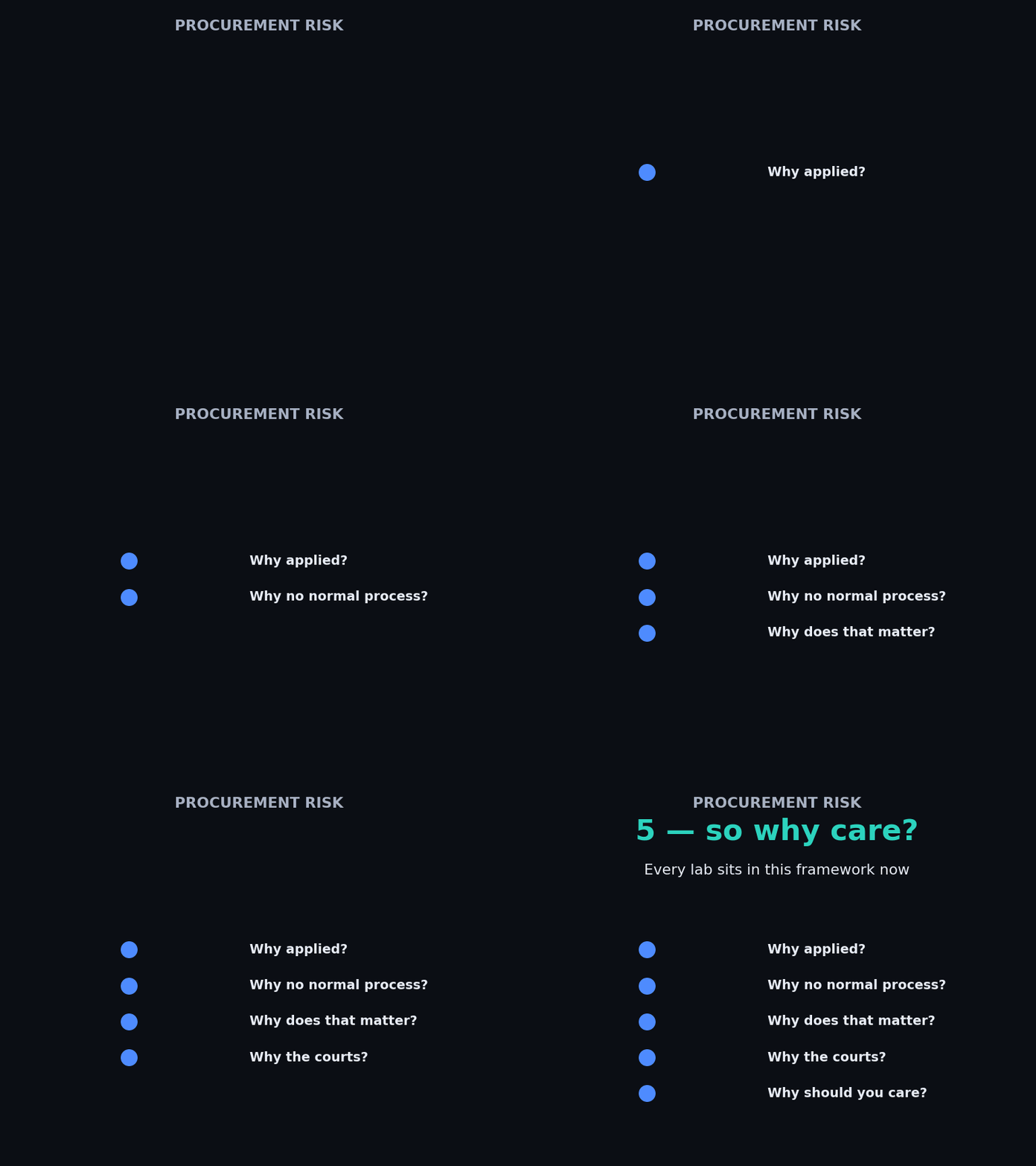
- Why was the label applied? The government determined, through internal risk assessment, that Anthropic carried enough supply-chain exposure to warrant the marker.
- Why didn’t it go through normal channels? Administrative labels of this type often bypass the slower, public, notice-and-comment machinery — speed and secrecy win over process.
- Why does that create a problem? Because a company can carry the label for months while its competitive and procurement position quietly erodes, with no way to contest it in real time.
- Why is the court involved? Because there’s no fast administrative appeal for this category of action — a slow-burn civil suit is the only lever a company like Anthropic has.
- Why should the rest of the industry care? Because every frontier-lab procurement relationship in the country now sits inside this same risk framework. Anthropic is the first to successfully contest it; its outcome writes the playbook for everyone else.
The first lawsuit vs. the second
Today’s win concerns the supply-chain label. The second, concurrent suit goes after treatment with even higher stakes — the carve-outs, restrictions, and (alleged) pressure points that shape how — or whether — Anthropic can do business with the federal government at all. One is a status correction; the other is a structural fight.
That ordering is a deliberate legal strategy. Win the label first, reset the frame, then argue the bigger structural claims from a stronger position.
What this does and doesn’t mean
Does mean: a real precedent that administratively tagging a major AI vendor requires a defensible basis. Companies being labeled without process now have a citation.
Doesn’t mean: Anthropic is “free” of federal scrutiny, or that the government has conceded the second, larger case. Labels can be re-applied through corrected processes. Frameworks rarely vanish because one suit wins.
The bottom line
AI procurement is becoming ordinary government business, and ordinary business brings ordinary legal process. Anthropic’s win is the first sign of a mature, contested market — one where even the most powerful AI companies can push back against an out-of-band Washington label and win.
The embedded “5 whys” is the kind of structural analysis that separates a deep read from a headlined headline. For the trade, it’s not whether the government can label a lab a risk — it’s what it must prove, and to whom, when it does.